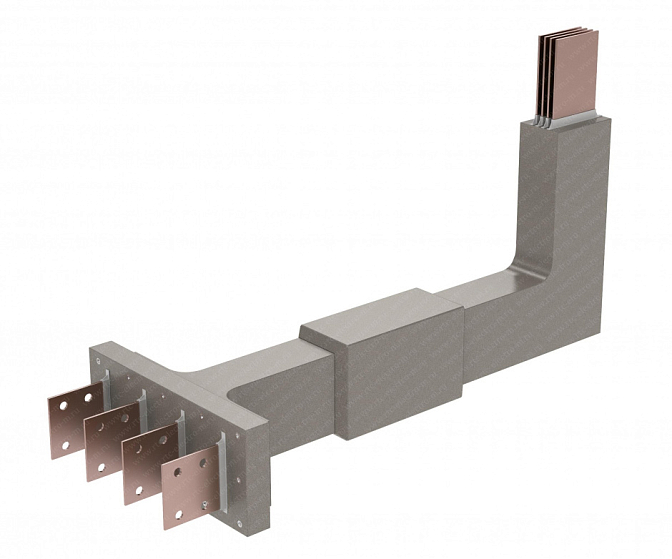
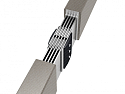
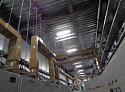
TKLN Busway consists of sections of various configurations. A busway section (Fig. 1) is made of parallel copper or aluminum busbars with a rectangular cross-section, enclosed in insulating material, which is a special compound produced by casting and saturated with fine-grained inert particles. The compound has excellent dielectric properties, high mechanical strength, and is highly fire- and chemical-resistant. Sections are manufactured with a maximum length of 6 meters.
At the installation site, all connections between busway sections are filled with compound, ensuring continuous insulation along the entire route with an IP68 protection rating against dust and water. The design of the section joints also compensates for construction deviations.

Fig. 1. TKLN Busway Sections
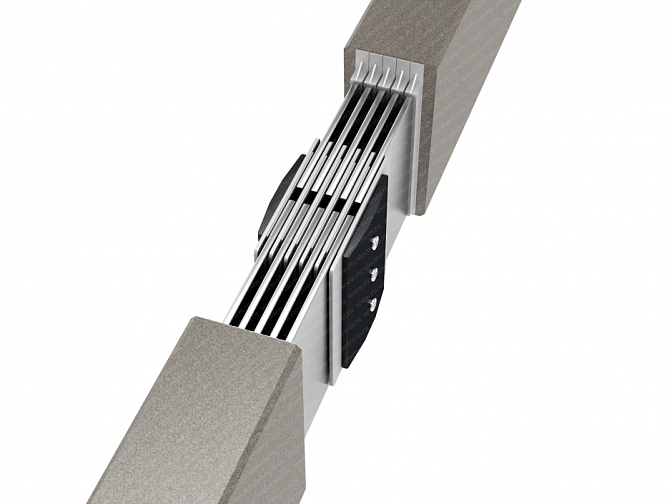
Busway sections (Fig. 2) are connected using a special set of connecting plates and insulating partitions, fastened together with screws. After installing the connecting kit and tightening the screws, the joint is filled with the same type of compound prepared on-site (for a detailed description of the section connection process, see the catalog, p. 34).

Fig. 2. Connection of TKLN Busway Sections
Special "terminal sections" (Fig. 3) are manufactured for connection to various electrical equipment. Terminal sections can be made in different configurations depending on the project requirements. The terminals have holes for bolted connections with electrical equipment (for more details on terminal sections, see the catalog, pp. 15–27).

Fig. 3. Terminal Sections of TKLN Busway
To compensate for thermal expansion of the busway, special "compensation sections" are used (Fig. 4). The average installation interval is 30 meters for busways with copper busbars and 25 meters for busways with aluminum busbars. The exact placement is determined based on the specific route configuration of the project.

Fig. 4. Compensation Section of TKLN Busway
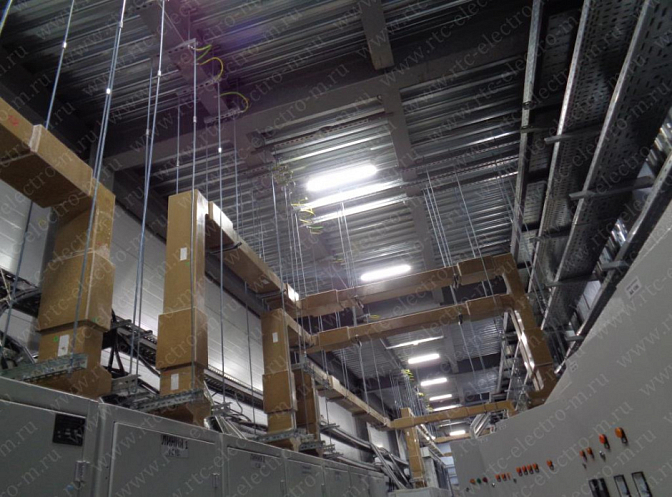
The busway can also be equipped with cabinets containing current and voltage transformers, branch devices for cable connections, and protective covers with busbars and compensators for connecting the busway to transformer outputs and low-voltage switchgear (LV cabinets). The list of busway components is defined by the assembly drawing developed for the specific site. Upon customer request, busbar contacts can be plated with tin, nickel, or silver.

Fig. 5. Connection of TKLN Busway to Equipment